
Good lighting is usually judged on how a space feels. The work that makes it safe, compliant and efficient sits underneath, in calculations most people never see. Every lighting design carries an electrical design with it — illuminance targets, luminaire counts, circuit loads, cable sizes, and the protective devices that keep the whole system inside the wiring rules.
On a commercial project in Sydney, that engineering is the difference between a scheme that passes certification and runs for years, and one that trips on switch-on, over-lamps a space, or fails a Section J energy check. Here is the sequence a lighting design actually follows, and where the technical judgement lives.
Below is an example of how an electrical engineer approaches the lighting design for a simple interior space.
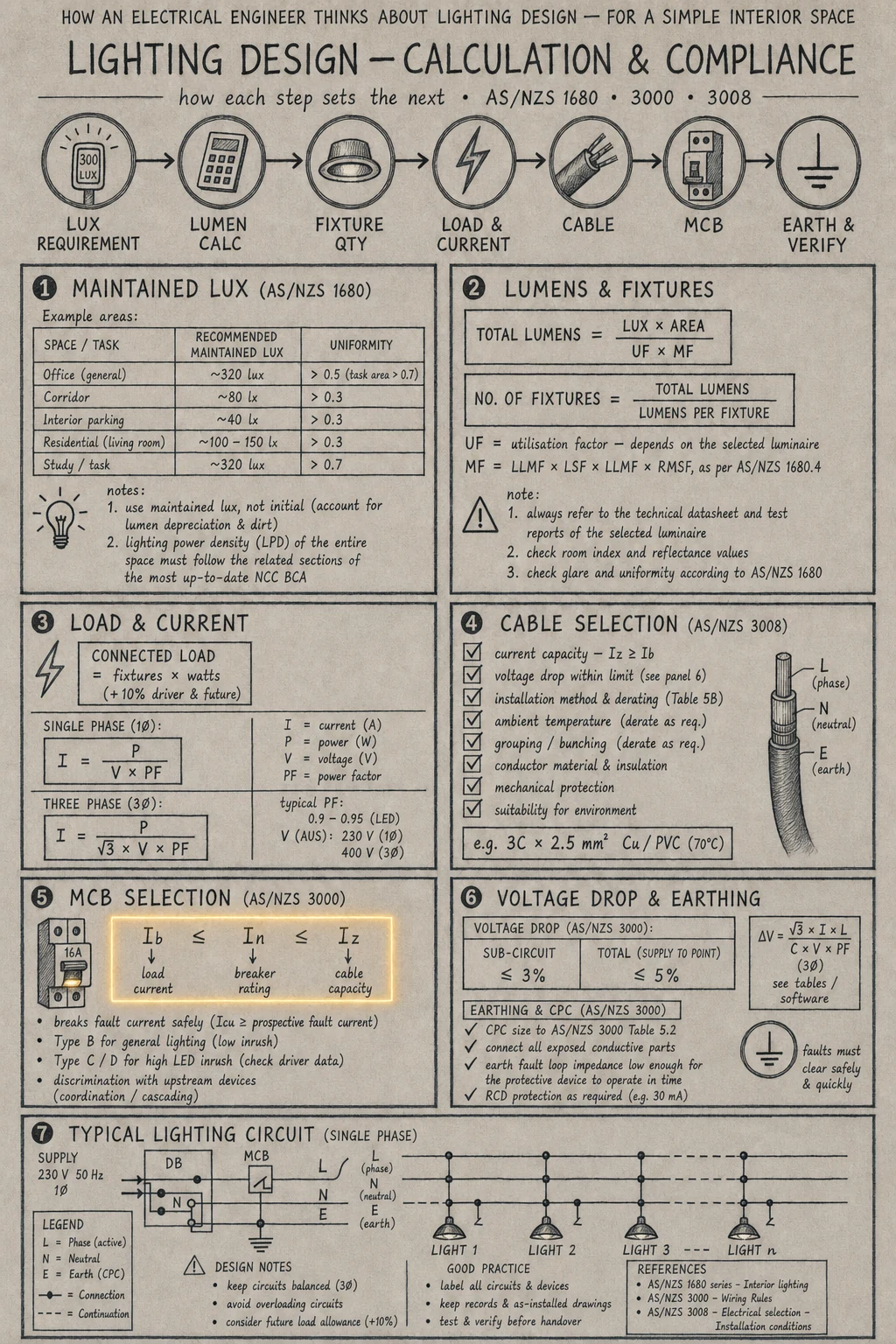
The design workflow, step by step
1. Set the illuminance target. Every space has a job, and the maintained illuminance follows the task. Under AS/NZS 1680, a general office commonly targets around 320 lux — higher again for detailed or screen-intensive work — while a general parking area sits well below that. "Maintained" is the operative word: the figure is the level held at the end of the maintenance cycle, after lumen depreciation and dirt, not the level on the day the lamps are first switched on.
2. Calculate lumens and luminaire count. With a target lux, the room's area and geometry, and the surface reflectances, the total required lumens follow — and from there the number of luminaires, accounting for the utilisation factor and light loss factor. Over-specify and the scheme wastes energy and capital; under-specify and the space drops below its target within a single maintenance cycle.
Furthermore, the total lighting power density (LPD) for the space must conform to the maximum limits set by the current NCC Volume One. A Class 5 space, for example, must not exceed the maximum LPD thresholds specified in Section J7 of NCC Volume One. Note that in NSW, NCC 2022 is still in effect; NCC 2025 comes into effect in May 2027.
3. Estimate the electrical load. Each luminaire's driver load adds up to a circuit demand. That figure sets the current the circuit has to carry, and it feeds everything downstream — cable size, protective device, and the building's maximum demand.
4. Size the cable and select protection. Conductor size is chosen for current-carrying capacity under AS/NZS 3008, derated for grouping, installation method and ambient temperature, then coordinated with the protective device. The MCB is selected to protect the cable and the circuit, with its rating and tripping curve matched to the load. LED lighting is exactly where the curve choice earns its keep — see below.
5. Verify voltage drop and earthing. A long lighting run can lose enough voltage to matter. AS/NZS 3000 caps total voltage drop at 5% from the point of supply, so the design is checked and, where needed, the cable is stepped up a size. Earthing and the circuit protective conductor are confirmed so a fault clears safely and quickly.
Skip any one of these and the problem surfaces later — as a nuisance trip, a dim corner, a failed inspection, or an energy report that does not add up.
Why LED-only circuits trip: the inrush problem
Modern commercial lighting is almost entirely LED, and LED drivers behave differently to the loads the old rules of thumb assumed. At switch-on, the driver's input capacitors charge within a few milliseconds and pull an inrush current many times the steady-state rating for that short burst.
Put enough drivers on one circuit and the combined inrush can trip a standard Type B MCB the instant the lights are energised — even though the running load is comfortably within rating. The fixes are engineering decisions, not guesswork: choose a tripping curve suited to the inrush (Type C or D where the driver data warrants it), cap the number of drivers per circuit against the manufacturer's inrush figures, and stage the switching so banks energise in sequence. Resolving this at design time costs a line in a calculation; chasing a "random" trip after handover costs a site visit and a certifier's second look.
Where the standards sit
An Australian lighting design answers to several standards at once:
- AS/NZS 1680 — interior and outdoor workplace lighting: illuminance targets and lighting quality.
- AS/NZS 1158 — exterior lighting for roads and public spaces.
- AS/NZS 2560 — sports lighting.
- AS/NZS 2293 — emergency lighting.
- AS/NZS 4282 — control of the obtrusive effects of outdoor lighting.
- AS/NZS 3000 — the wiring rules: circuit arrangement, voltage drop, earthing and protection.
- AS/NZS 3008 — cable selection and current-carrying capacity.
- NCC / BCA — energy efficiency, including illumination power density limits for the building.
Designing to the picture and back-filling the compliance afterwards is where projects lose time. Carrying the standards through each calculation keeps certification straightforward.
What this means when you're specifying lighting
For an architect, developer or builder, the visible deliverable is a lighting scheme. The value is the layer beneath it — the calculations that make the scheme buildable, certifiable and efficient, done by someone with no stake in which fixtures get bought.
That independence is the point. A consultant who does not sell luminaires specifies to the brief and the standard, not to a product range. The lux levels, the cable schedule, the protection and the energy numbers are worked for the project, and they hold up when the certifier, the electrician and the energy assessor each check their part.
FAQ
Do I need a lighting designer, or can the electrician handle it?
An electrician installs and certifies the wiring. A lighting design consultant sets the illuminance and quality targets, runs the photometric calculations, and coordinates the electrical design so the installed result meets AS/NZS 1680 and the project brief. On anything past a simple fit-out, the two roles are complementary — the full division of responsibilities is set out in what a lighting designer actually does.
What lux level does my space need?
It depends on the task. For example, AS/NZS 1680 gives maintained illuminance targets for interior spaces by application — offices, retail, warehouses and car parks each have their own. The right number is the maintained level for that specific space, not one figure applied everywhere.
Why do my new LED lights trip the breaker when nothing looks overloaded?
Almost always inrush current. Too many LED drivers on one circuit, protected by a breaker with the wrong tripping curve, trip on switch-on despite a low running load. It is a design fix — curve selection, drivers per circuit, and staged switching.
IEC 60364 or AS/NZS 3000 — which applies here?
IEC 60364 is the international wiring standard many overseas guides quote. In Australia the governing document is AS/NZS 3000, which sets the local rules for voltage drop, earthing and protection. A design built for the Australian market is worked to AS/NZS, not the international reference.
SL Design Consultant is an independent lighting and electrical design consultancy in Sydney, delivering lighting and electrical design across commercial, hospitality, retail, heritage and public projects. Our product-neutral recommendations are guided by design intent, technical performance and project requirements.